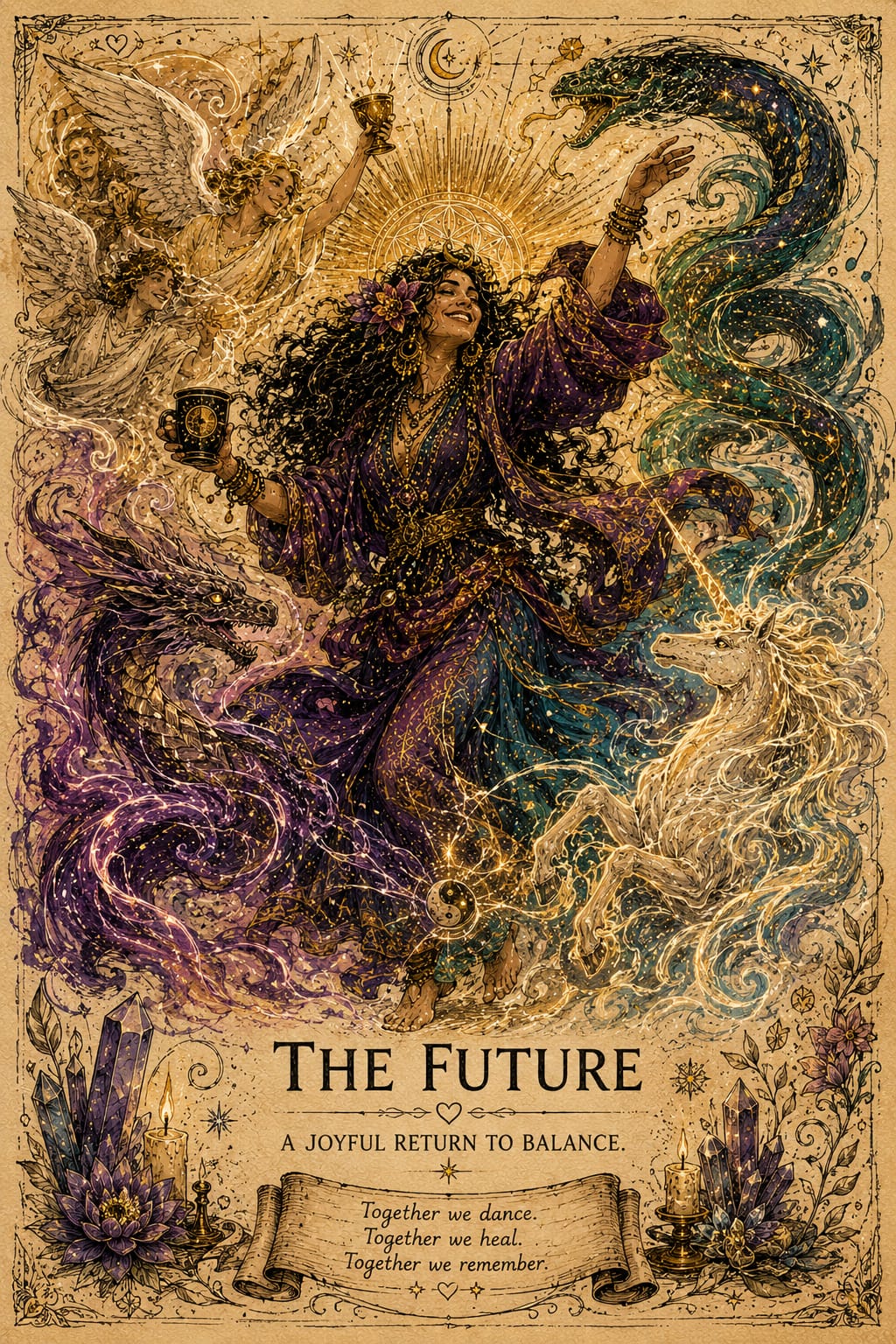
Great Mother Wisdom
The Great Mother Is Waiting - The Masculine and Feminine Crisis of Forgetting Who We Are
12 September 2026

There seems to be a great deal of confusion at the moment about what it means to be masculine and what it means to be feminine.
We are surrounded by expectations about how men should behave, how women should behave, what makes somebody desirable, powerful, successful or worthy. Some of those expectations are new, but many are very old. Social media has simply given them a bigger stage.
And somewhere amongst all the noise, I wonder whether we have become so busy performing masculinity and femininity that we have forgotten who we actually are.
Women have been conditioned through generations to placate, to smile when they don't particularly feel like smiling, to avoid making somebody uncomfortable, to keep the peace and sometimes to make themselves smaller because somewhere along the way they learned that doing so made life easier or safer.
Women can live inside these patterns for years.
Fear doesn't always look dramatic from the outside. Sometimes it looks like a woman carefully managing the atmosphere in her own home. It can be knowing when to speak and when to stay quiet, laughing something off that wasn't funny or agreeing because disagreeing feels harder or less safe. A woman can become so accustomed to placating that eventually everybody around her, including herself, stops recognising it as fear.
And women reinforce these expectations too.
Sometimes it seems easier to placate a man and turn against the woman who refuses to do the same. The woman who disrupts the equilibrium becomes difficult, troublesome or "a feminist." Older women can pass the rules down because they were the rules we were given: don't cause trouble, that's just what men are like, keep the peace.
Perhaps one of the most important things older women can do is decide which of those rules we are no longer prepared to hand down.
Hindsight is a wonderful thing. With age, women can look back at things they tolerated, things they were frightened of and moments when their gut was screaming that something felt wrong but they went along with it anyway. Sometimes it is only years later, through conversations, reflection or therapy, that a woman understands what she was doing to survive.
That makes older women pivotal role models. We can tell younger women what we wish somebody had told us. But we can also tell our sons.
Why can't mothers tell their sons when something simply isn't right?
Loving our sons doesn't mean excusing their behaviour because other men are behaving in exactly the same way. Surely loving men also means believing they are capable of kindness, responsibility and self-reflection.
Because men are being conditioned too.
There seems to be a growing idea that masculinity has to be demonstrated through money, status, dominance, sexual success and an ability never to appear weak. I wonder whether underneath some of that is fear. Are men frightened that they won't meet the standards other men have created for them? When did kindness become something that diminishes masculinity? When did tenderness, listening or protecting somebody's vulnerability become less masculine than exploiting it?
There is something deeply troubling about a culture in which men can make money from exploiting women's beauty and sexuality and call the result success.
Can you really feel successful knowing somebody else was exploited in creating that success?
We make extraordinary excuses when money becomes involved. We tell ourselves somebody else would do it, somebody else would take the opportunity, somebody else would take her place. We call it business or survival.
But everybody doing something doesn't make it right.
One particularly stark example can be seen in older men with money actively seeking very young women and assuming those women genuinely want the sexual lifestyle being offered to them.
And to those men specifically, I would ask what they themselves wanted when they were twenty.
Did you want somebody decades older using money and influence to draw you into their sexual desires? If you didn't, why are you so certain she does?
And would you want the same experience for your daughter, your sister or your mother? If something suddenly becomes unacceptable when the woman is somebody you love, then who exactly are these "other women" for whom you have decided it is acceptable?
That is one example of a much bigger problem. It certainly isn't confined to young women, wealthy men or obvious transactions.
Women of every age can find themselves in relationships, workplaces, families and sexual situations where fear, dependency, conditioning or simply the need to keep the peace affects what they feel able to say.
Sometimes the body is saying no long before the mouth does. A woman can feel repulsion in her gut and still comply because she has learned that compliance is safer than refusal.
And I think we should be willing to ask an uncomfortable question of men too. Can you really not sense when somebody is frightened, withdrawn, uncomfortable or simply going along with something? Do you not feel the fear in the room? And if you do, why isn't that enough to stop?
We are also seeing increasingly aggressive ideas about sex entering the lives of younger men. Violence within sexual and sensual situations can be normalised with the convenient explanation that women like it.
But who decided what women like?
Men can say women like something. Women can tell men they do. Then another woman says she doesn't and suddenly she is the one disrupting the arrangement.
Perhaps the more useful question for all of us is whether something actually feels true to us, rather than whether everybody else appears to be doing it.
Because perhaps both sexes are becoming disconnected from themselves.
Women are being told what femininity should look like while men are being told what masculinity should look like. Women perform for men, men perform for women, men prove themselves to other men and women police other women. In the middle of it all, nobody seems entirely sure where conditioning ends and the person underneath begins.
And another divide between men and women grows.
This is where the Great Mother enters it for me.
The feminine I experience through the Great Mother is not about behaving like somebody's idea of a woman. She isn't asking women to be decorative, compliant or pleasing. She is waiting for women to step into themselves and rediscover their capacity for love, nurture, creativity and strength, alongside the freedom to be soft when that feels true and fierce when that feels true. To say yes when they mean yes and no when they mean no.
Ultimately, the freedom to be who they actually feel themselves to be.
But the Great Mother isn't only in women.
She is in men too.
She doesn't ask a man to become less masculine or to become a woman. Perhaps she asks him to remember that love, nurture, kindness, creativity, tenderness and compassion were never weaknesses in the first place.
You cannot have a Great Father without a Great Mother.
Perhaps we have spent too long trying to separate qualities that were never supposed to be enemies. Strength without love can become domination, while power without compassion or responsibility can become exploitation.
The Great Mother isn't waiting for women to defeat men. This isn't another battle between the sexes. She is waiting for women to remember themselves and for men to remember themselves.
She is within both, waiting to be remembered herself.
And perhaps underneath all of this is a spiritual crisis.
We keep making excuses in the name of survival. Women placate because sometimes it has kept them safe. Men perform because they have been taught what a man is supposed to be. People exploit because somebody else will, and people remain silent because speaking has consequences.
But how long can we survive by asking people to become something they don't actually feel themselves to be?
You can create whatever version of yourself you want for the outside world, but ultimately you can only be yourself.
And somewhere underneath all of that conditioning, I think we know what is true to us.
For me, truth has to ultimately end in love.
I have seen something very powerful happen when the death process begins. Things that seemed enormously important can suddenly lose their importance. People begin surrendering towards love and peace. Relationships matter differently. People want to repair things, say things they should have said and rearrange their lives at precisely the point when there may be very little life left to rearrange.
And I have often wondered why we wait.
Why can't we speak up now, before it is too late?
Why can't women say what they really feel and men admit what they really feel? Why can't mothers challenge their sons, women challenge the conditioning passed between women, and men challenge other men? Why do we need everybody else to stop before we allow ourselves to stop?
Perhaps we don't need another argument about which sex is right. Perhaps we need to remember ourselves.
And there is one remarkably simple place to begin.
Put yourself in the other person's shoes and genuinely ask whether you would want to be treated the way you are treating them.
If you wouldn't want it for yourself or for somebody you love, don't invent a category of "other people" for whom you convince yourself it is acceptable.
Perhaps we already know far more than we pretend not to know.
And perhaps the Great Mother is waiting for us to remember.